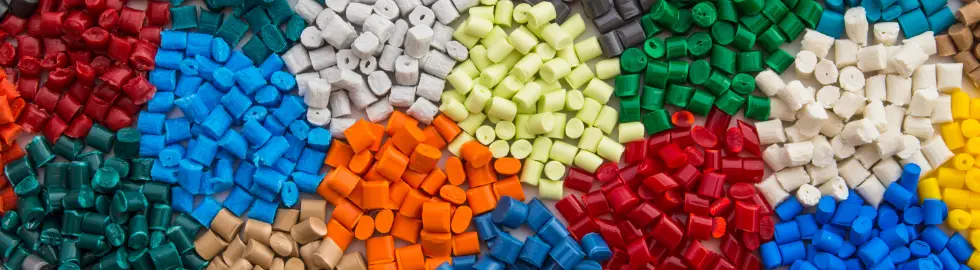
Plastic additives are substances that are added to plastic prior to or during the manufacturing process to improve and modify its characteristics. This workshop will cover the different types of plastic additives, their functions, and their interaction with each other. These additives aid in the actual processing of the plastic end product (e.g., antioxidants, nucleating agents, mold release agents, lubricants) or improve the characteristics of the final product (antimicrobials, colorants, antistatic agents, impact modifiers, and UV-stabilizers).
The growth in use of these additives is relatively strong and continuous. However, environmental constraints have imposed rigorous performance requirements on many products, adding expenses to the development costs of these materials. Moreover, a new trend is the development of biobased additives for bioplastics.
The desire to create a circular society presupposes that plastics are recycled. This might require re-stabilization of the plastics for fulfilling plastic products properties. Conventional additives are mostly used in this case but new types of additives have been developed for ascertaining that recycled plastic can be given a new life.
The workshop starts with a presentation of different mechanisms for degradation of plastics of a very simple reason: If the degradation processes are not well known, it is difficult to propose an adequate stabilization package.
Further, the course will cover analytical tools (DSC, TGA and MS) and many other instrumental techniques for identification and structure elucidation of plastic additives. The participants will also learn which tools are available for trouble-shooting.
Dr. Lennart Johansson is the manager for the Swedish Plastics Industry Association, SPIF. It consists of more than 100 small and medium size companies in Sweden. Presently he is a board member of Swedish Plastic Recycling, the biggest and most efficient plant for plastic recycling in Europe.
During his career Dr Johansson worked as the Manager of Process and polymer for Dyno Nobel; as Senior Scientist within the area of degradation and stabilization of plastics for ABB Corporate Research & Development, which resulted in five patents. Dr Johansson has given courses in more than seven countries during his carrier as a certified Instructor/Trainer during his position as manager for Polymer Support Sweden.
This course provides an overview of all significant aspects and considerations of plastic additives for process engineers, scientists, chemists and laboratory personal who are involved in the selection, application and troubleshooting. Moreover, this course is important also for procurers, purchasers, sale & marketing engineers in the fields of plastics.
Why Should You Purchase On Demand?
This course will provide participants with a comprehensive overview of plastic additives and equip them with the knowledge and skills to make informed decisions when selecting and using additives in plastic manufacturing processes.
Are you struggling with low performance of your materials or you have problems processing them?
Plastic additives are essential for enhancing material characteristics and ensuring product quality. Understanding how to select and use these additives is crucial for achieving reliable, high-performing end products.
Are you struggling with degradation issues in plastics and looking for effective stabilization solutions?
Plastics degrade over time due to environmental factors, such as UV radiation, oxidation, and mechanical stress. Identifying the mechanisms of degradation is the first step toward selecting the right stabilization package to extend the lifespan of your products.
Are you involved in recycling plastics and want to ensure they meet performance requirements?
Recycled plastics often require re-stabilization to restore their properties and meet quality standards. This workshop will explore conventional and emerging additives that give recycled materials a second life while supporting circular economy goals.
Are you concerned about the environmental impact of the additives?
As the demand for bioplastics increases, the development of biobased additives has become a key trend. Learn how these additives are shaping the future of sustainable plastics.
Do you need to analyze and troubleshoot additive-related issues in your plastic materials?
From processing aids to performance enhancers, understanding the interaction and identification of additives is vital. Discover the analytical tools, such as DSC, TGA, and MS, that are used for additive identification, structure elucidation, and troubleshooting.
If these challenges align with your needs, this workshop is designed for you!
Kim McLoughlin Senior Research Engineer, Global Materials Science Braskem
A Resin Supplier’s Perspective on Partnerships for the Circular Economy
About the Speaker
Kim drives technology programs at Braskem to develop advanced polyolefins with improved recyclability and sustainability. As Principal Investigator on a REMADE-funded collaboration, Kim leads a diverse industry-academic team that is developing a process to recycle elastomers as secondary feedstock. Kim has a PhD in Chemical Engineering from Cornell. She is an inventor on more than 25 patents and applications for novel polyolefin technologies. Kim is on the Board of Directors of SPE’s Thermoplastic Materials & Foams Division, where she has served as Education Chair and Councilor.
A Resin Supplier’s Perspective on Partnerships for the Circular Economy
About the Speaker
Gamini has a BS and PhD from Purdue University in Materials Engineering and Sustainability. He joined Penn State as a Post Doctorate Scholar in 2020 prior to his professorship appointment. He works closely with PA plastics manufacturers to implement sustainability programs in their plants.
A Resin Supplier’s Perspective on Partnerships for the Circular Economy
About the Speaker
Tom Giovannetti holds a Degree in Mechanical Engineering from The University of Tulsa and for the last 26 years has worked for Chevron Phillips Chemical Company. Tom started his plastics career by designing various injection molded products for the chemical industry including explosion proof plugs and receptacles, panel boards and detonation arrestors for 24 inch pipelines. Tom also holds a patent for design of a polyphenylene sulfide sleeve in a nylon coolant cross-over of an air intake manifold and is a Certified Plastic Technologist through the Society of Plastic Engineers. Tom serves on the Oklahoma Section Board as Councilor, is also the past president of the local Oklahoma SPE Section, and as well serves on the SPE Injection Molding Division board.
Joseph Lawrence, Ph.D. Senior Director and Research Professor University of Toledo
A Resin Supplier’s Perspective on Partnerships for the Circular Economy
About the Speaker
Dr. Joseph Lawrence is a Research Professor and Senior Director of the Polymer Institute and the Center for Materials and Sensor Characterization at the University of Toledo. He is a Chemical Engineer by training and after working in the process industry, he has been engaged in polymers and composites research for 18+ years. In the Polymer Institute he leads research on renewably sourced polymers, plastics recycling, and additive manufacturing. He is also the lead investigator of the Polyesters and Barrier Materials Research Consortium funded by industry. Dr. Lawrence has advised 20 graduate students, mentored 8 staff scientists and several undergraduate students. He is a peer reviewer in several journals, has authored 30+ peer-reviewed publications and serves on the board of the Injection Molding Division of SPE.
Matt Hammernik Northeast Account Manager Hasco America
A Resin Supplier’s Perspective on Partnerships for the Circular Economy
About the Speaker
Matt Hammernik serves as Hasco America’s Northeast Area Account Manager covering the states Michigan, Ohio, Indiana, and Kentucky. He started with Hasco America at the beginning of March 2022. Matt started in the Injection Mold Industry roughly 10 years ago as an estimator quoting injection mold base steel, components and machining. He advanced into outside sales and has been serving molders, mold builders and mold makers for about 7 years.
84 countries and 85.6k+ stakeholders strong, SPE
unites
plastics professionals worldwide – helping them succeed and strengthening their skills
through
networking, events, training, and knowledge sharing.
No matter where you work in the plastics industry
value
chain-whether you're a scientist, engineer, technical personnel or a senior executive-nor
what your
background is, education, gender, culture or age-we are here to serve you.
Our members needs are our passion. We work hard so
that we
can ensure that everyone has the tools necessary to meet her or his personal & professional
goals.
3Dnatives Europe
157 Boulevard Macdonald
75019, Paris, France More
Information
Powered By SPE
This educational program is provided as a service of SPE. The views and opinions expressed on this or any SPE educational program are those of the Speaker(s) and/or the persons appearing with the Speaker(s) and do not necessarily reflect the views and opinions of the Society of Plastics Engineers, Inc. (SPE) or its officials, employees or designees. To comment or to present an opposing or supporting opinion, please contact us at info@4SPE.org.
Refund Policy
Full refund 30 days prior to the event start date. Please contact customerrelations@4spe.org for assistance with registration.
Copyright & Permission to Use
SPE may take photographs and audio/video recordings during the conference, pre-conference meetings and receptions that may include attendees within sessions, networking areas, exhibition areas, and other areas associated with the conference both inside and outside of the venue. By registering for this event, all attendees are providing permission for SPE to use this material at its discretion on SPE's websites, marketing materials, and publications. SPE retains ownership of copyright to all photographs and audio/video recording obtained at this event and attendees may request copies of any material in which they are included.
Anti-Trust Statement
No discussion among members, volunteers, or staff, which attempts to arrive at any agreement regarding prices, terms or conditions of sale, distribution, volume, territories, or customers;
No activity or communication which might be construed as an attempt to prevent any person or business entity from gaining access to any market or customer for goods or services or any business entity from obtaining services or a supply of goods;
No activity or communication which might be construed as an agreement to refrain from purchasing or using any materials, equipment, services or supplies of or from any supplier; or
No other activity which violates anti-trust or applicable laws aimed at preventing unfair competition.